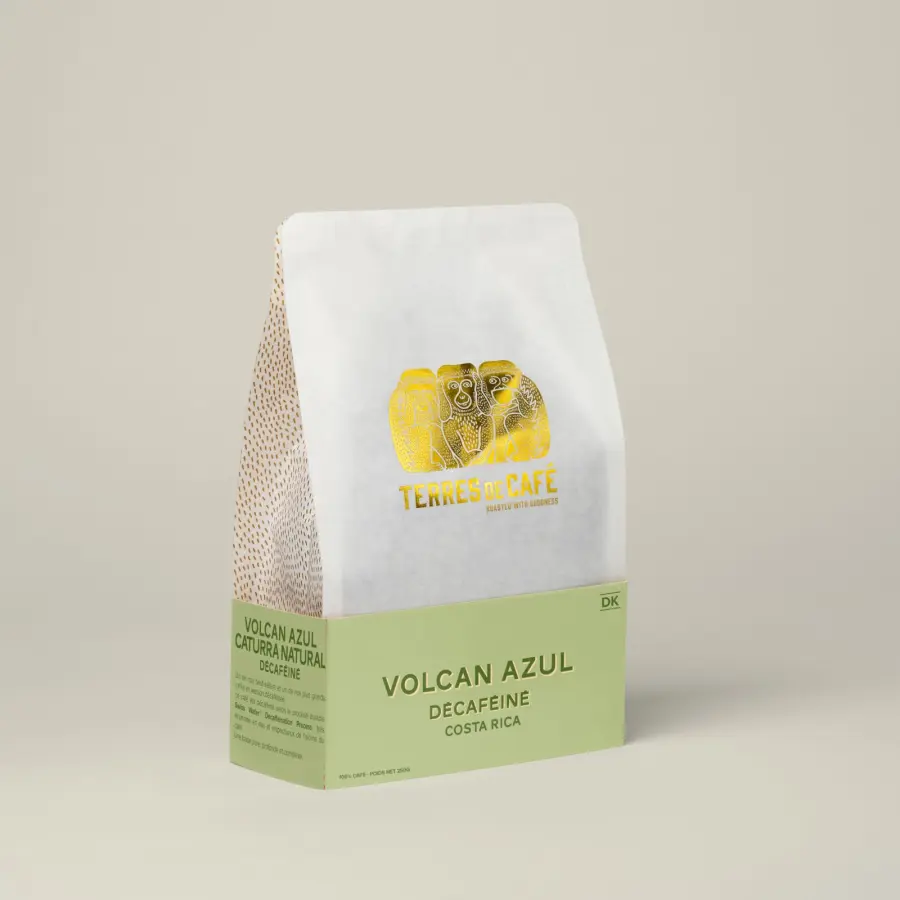
Price €24.90
Coffee Volcan Azul...
COSTA RICA - 150g
Decaf whole bean coffee can retain all the character of a great specialty coffee, delivering a rounded and aromatic cup with significantly less caffeine. Our two decaf coffees are water decaffeinated using the Swiss Water Process, a method designed to remove caffeine while preserving the coffee beans' aromatic qualities.
Prefer coffee that is ready to brew? Discover our selection of ground coffee. To get the best from your beans, explore our range of coffee machines and coffee makers for different brewing methods.
Looking for a blend rather than a single-origin coffee? Our coffee blends offer another way to explore different flavour profiles. And if farming practices are an important part of your choice, discover our selection of certified organic coffees.
There is 1 product.
COSTA RICA - 150g
A great decaf whole bean coffee is far removed from the bland cup sometimes associated with decaffeination. Our two decaf coffees are selected and artisanally roasted in the Paris region with the same attention to quality as the rest of our range.
The main difference is that most of the caffeine is removed from the green coffee beans before roasting. The decaffeination process can influence the physical and sensory characteristics of the beans, which is why the roasting profile must be carefully adapted to reveal their aromatic potential.
At Terres de Café, these coffees are grouped within a dedicated decaf coffee range, separate from the SCA score categories – 80+, 85+ and 88+ – used elsewhere in our coffee selection.
Water decaffeination is a method designed to remove caffeine from green coffee without directly using conventional chemical solvents such as methylene chloride or ethyl acetate.
With the Swiss Water Process, water, coffee extract and carbon filtration are used to selectively remove caffeine while preserving as much of the coffee's original aromatic character as possible.
The process is based on differences in concentration and filtration: caffeine moves out of the green coffee beans and is removed from the liquid using specialised carbon filters, while the process is carefully controlled to limit the loss of other soluble compounds.
Combined with careful artisanal roasting, this method makes it possible to produce decaf coffee beans with a distinctive aromatic profile, allowing you to enjoy espresso and other coffee preparations while significantly reducing your caffeine intake.
As with caffeinated coffee, whole bean decaf coffee gives you greater control over freshness and grind size. Grinding only the amount you need immediately before brewing helps preserve aromatic qualities and allows you to adapt the grind precisely to your brewing method.
If you do not have a coffee grinder, you can choose the same coffees in a pre-ground format. The appropriate coffee grind size depends primarily on your equipment: a fine grind is generally used for espresso, while filter coffee makers and French presses require different, typically coarser grind settings.
The general storage principles for decaf coffee beans are similar to those for regular coffee. Keep the beans away from light, heat, moisture and significant temperature fluctuations.
Store your coffee in its original resealable bag or a suitable airtight container at a stable room temperature. For everyday storage, a cool, dry cupboard is generally preferable to the refrigerator, where repeated exposure to moisture and temperature changes can affect the coffee.
Yes. The decaffeination process removes the vast majority of caffeine from green coffee beans before roasting. Decaf coffee is not necessarily completely caffeine-free, however, as a small residual amount may remain.
Our two current references are water decaffeinated using the Swiss Water Process, a method that does not directly use conventional chemical solvents and is designed to preserve the coffee's aromatic characteristics as much as possible.
Decaffeination can influence the sensory characteristics of coffee, so a decaf will not necessarily taste exactly the same as its caffeinated equivalent. However, carefully selected green coffee, an appropriate decaffeination process and a well-adapted roast profile can preserve a distinctive expression of the coffee's origin.
Our current decaf coffees illustrate this diversity with flavour profiles ranging from cocoa and citrus to chocolate, almond and coconut.
Yes, although the result will depend on the coffee's roast profile, grind size and brewing recipe. Our two current decaf coffees are roasted primarily with espresso in mind, but they can also be explored with other brewing methods by adapting the grind and extraction parameters.