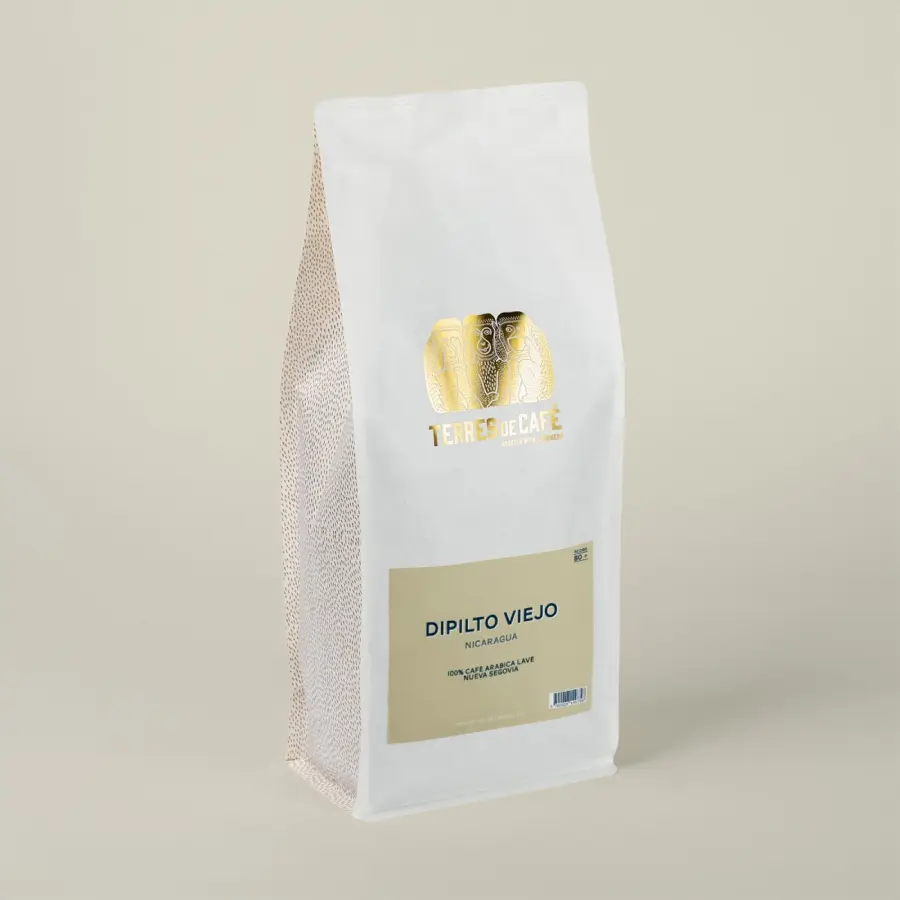
Price €46.90
Coffee Dipilto Viejo
NICARAGUA - 1kg
Nicaraguan coffee is one of the most balanced coffee origins in the Americas. Grown at high altitudes across volcanic terroirs, it develops refined aromas, often characterised by fruity notes, caramel and remarkable sweetness. At Terres de Café, each Nicaraguan coffee is selected through direct relationships with producers, ensuring full traceability from bean to cup. Our specialty coffees are available as whole bean coffee, ground coffee and Nespresso-compatible coffee capsules. To explore other Latin American coffee origins, discover our selection of Peruvian coffee, offering an equally distinctive character and the same commitment to quality, origin and traceability.
There is 1 product.
NICARAGUA - 1kg
Nicaragua has gradually established itself as a recognised origin in the world of specialty coffee. The country benefits from favourable geographical conditions, including high elevations in the mountainous regions of the north, rich volcanic soils and a climate with distinct dry and rainy seasons. Together, these conditions can encourage slower cherry maturation and contribute to the development of complex flavours in the cup.
Nicaraguan coffee is often appreciated for its balance, combining moderate acidity, a rounded body and flavour notes that can include caramel, yellow fruit, nuts and chocolate. Rather than being dominated by sharp acidity, coffees from Nicaragua can appeal both to those discovering specialty coffee origins and to experienced coffee drinkers looking for complexity and balance.
Nueva Segovia, in northern Nicaragua, is one of the country's best-known coffee-growing regions. Many coffees are cultivated at high elevations, where cooler temperatures can slow the development of the coffee cherries and contribute to greater aromatic complexity. The region is particularly renowned for producing dense beans with distinctive and well-structured flavour profiles.
Altitude is one of several important factors influencing the character of Nicaraguan coffee. Higher elevations are generally associated with cooler growing conditions and slower cherry maturation, while variety, soil, rainfall, farming practices and processing methods all contribute to the final sensory profile.
Nicaragua primarily produces Arabica coffee, including varieties such as Caturra, Catuaí and Bourbon, as well as Maragogipe, a variety known for its particularly large coffee beans. Each variety interacts differently with its terroir, helping to explain the diversity of coffees found from one farm or region to another.
In terms of processing, the washed process is widely used: the coffee cherries are depulped before undergoing fermentation and washing, followed by drying. Washed coffees are often appreciated for their clarity and well-defined flavour characteristics.
Some producers also use natural or Honey processes, which can emphasise different sensory characteristics such as sweetness, fruitiness and body. These different processing methods allow coffees from similar terroirs to express remarkably different profiles from one farm or lot to another, contributing to the diversity of Nicaraguan specialty coffee.
At Terres de Café, our selection of Nicaraguan coffee beans is based on close relationships with producers. Each lot comes from identified farms or producer organisations, allowing us to provide detailed traceability including the coffee's origin, producer, region and growing conditions whenever this information is available.
These relationships also give us a deeper understanding of the coffees we select. By knowing the origin and characteristics of each lot, we can develop a roast profile designed to highlight its individual sensory qualities rather than standardising its flavour.
Our coffees are artisanally roasted in the Paris region to reveal the distinctive character of each Nicaraguan origin.
Whole bean coffee: ideal if you grind your coffee immediately before brewing. Keeping coffee as whole beans helps preserve its aromas for longer and allows you to adjust the grind size to suit your brewing method, whether you use an espresso machine, filter coffee maker or French press.
Ground coffee: a convenient option for everyday brewing. Choose a grind size suited to your preparation method and store the coffee carefully after opening to help preserve its aromatic qualities.
Nespresso-compatible coffee capsules: a practical format for quick and consistent preparation. Capsules offer an easy way to enjoy the character of specialty coffee using a compatible capsule machine.
For a different coffee experience, our coffee blends combine carefully selected origins to create balanced and consistent flavour profiles, roasted with the same attention as our single-origin coffees.
Explore our selection of Nicaraguan coffees and choose the format that best suits your brewing routine, from whole bean and ground coffee to capsules, with delivery available in France and internationally.
Nicaraguan coffees can offer balanced flavour profiles with notes of caramel, yellow fruit, nuts and sometimes chocolate. Many coffees from the country combine moderate acidity with a rounded body, although the exact profile varies according to region, variety, processing method and roast.
Nueva Segovia, in northern Nicaragua, is one of the country's most renowned specialty coffee-growing regions. Its high-elevation growing areas and varied terroirs can produce dense, complex and well-structured coffees.
Nicaragua grows several Arabica coffee varieties, including Caturra, Catuaí and Bourbon. Maragogipe, known for its unusually large beans, is also cultivated in the country and can produce distinctive sensory profiles depending on terroir and processing.
Store your Nicaraguan coffee in its original resealable bag or a suitable airtight container, away from light, heat and moisture, at a stable room temperature. If you buy whole bean coffee, grind only the amount you need immediately before brewing to help preserve its aromatic qualities.